Showing posts with label peacekeepers. Show all posts

Tuesday, 31 March 2015

140 Bangladeshi policemen off to join United Nations peacekeeping mission


140 BANGLADESHI POLICEMEN OFF TO JOIN UNITED NATIONS PEACEKEEPING MISSION
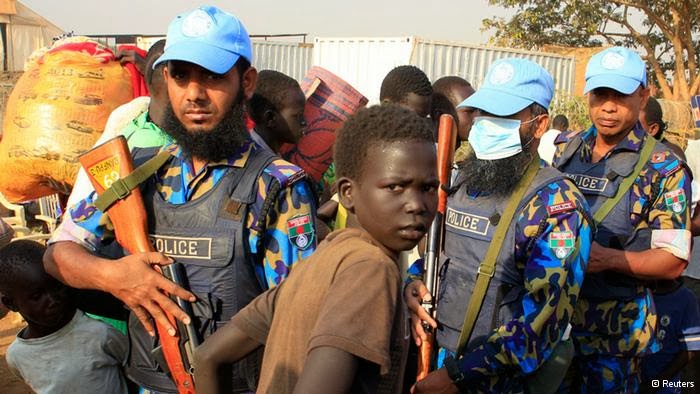
Dhaka: A total of 140 members of Bangladesh Police left Dhaka for Darfur of Sudan in a bid to join the United Nations (UN) peacekeeping mission there. The police contingent left Hazrat Shahjalal International Airport by a hired U.N plane early Saturday.  The Superintendent of Police Sarwar Murshid Shamim is being charged as the chief of contingent.


The contingent will replace existing BANFPU in South Sudan. Senior police officers saw off the Police contingent at the Hazrat Shahjalal International airport. According to the Police Headquarters, a total number of 1376 Bangladeshi policemen have been performing their duties efficiently on different United Nations Peacekeeping Missions in various countries, including Congo, South Sudan, Darfur, Ivory Coast, Mali and Haiti. 

Friday, 5 September 2014

Landmine kills four U.N. soldiers, wounds 15 in northern Mali

Landmine kills four U.N. soldiers, wounds 15 in northern Mali

BAMAKO (Reuters) - Four United Nations soldiers were killed on Tuesday and a further 15 were wounded when the convoy they were traveling in struck a landmine in an area of northern Mali where attacks are on the rise, a spokesman for the country's U.N. mission said.

The contingent had left a U.N. base in the town of Aguelhok and were traveling south when the blast occurred at around noon local time (8.00 a.m. EDT), about 30 km (19 miles) north of Kidal, the spokesman said.

He had earlier said the convoy was traveling north from Kidal when it struck the mine.

"The toll is four dead and 15 wounded, including six very seriously," Olivier Salgado told Reuters. "This is only a provisional toll because we do not know what will happen with six of the very seriously wounded."

Salgado said the mission, known by its acronym MINUSMA, was investigating the incident but could not immediately say who was responsible for the attack.

The soldiers were part of a contingent from Chad, said a U.N. official who asked not to be named.

U.N. peacekeepers continue to be targeted in sporadic attacks despite a successful French-led intervention last year that drove back Islamists who had taken advantage of a separatist uprising to seize Mali's desert north.

Tuesday's incident occurred amid a rise in violence against U.N. personnel and vehicles in and around Aguelhok. Thirteen rockets have been fired at the town's U.N. base alone over the past week though those attacks had not resulted in any deaths or injuries, Salgado said.

"I am outraged by such a surge in violence against peace soldiers," MINUSMA head Albert Koenders said in a statement. "A peace process is under way, some people want to compromise it. This is totally unacceptable and irresponsible."

Al-Qaeda linked Islamist fighters swept in and took control of the northern two-thirds of Mali in early 2012 following a military coup in the capital Bamako, which was launched in reaction to an uprising by Tuareg separatists.

The Tuareg groups, who initially worked with the Islamists, were later sidelined by their better armed allies. They were not targeted by last year's French-led military operation, and the government in Bamako agreed to open talks with them.

Negotiations between government representatives and the Tuareg groups resumed in Algeria's capital Algiers this week.

Malian Foreign Minister Abdoulaye Diop said on Monday that the government hoped to clinch a preliminary peace deal with the separatists within eight weeks.

Mali's northern desert region - called Azawad by the Tuareg rebels - has risen up four times in the last 50 years, with various groups fighting for independence or self-rule.


(Reporting by Souleymane Ag Anara; Additional reporting and writing by Joe Bavier,; Editing by Daniel Flynn and Angus MacSwan)

Thursday, 29 May 2014

UN Peacekeeping: A Force for the Future

By Hervé Ladsous, Under Secretary General for the United Nations Department of Peacekeeping Operations, and Ameerah Haq, Under-Secretary-General for the United Nations Department of Field Support.
UNITED NATIONS Peacekeeping
A Force for the Future

It was a dark, February night in the hilly North Kivu province of Eastern Congo. At 02h45 a small, silent Unarmed Unmanned Aerial Vehicle, circled the sky around a village in Masisi territory and sent back live video of a group of armed men who had recently overrun a local military post. As the UUAV relayed pictures to a control room, senior military officers prepared to move their soldiers if the civilian populations in the area were directly threatened.

The attack never materialized, but if it had, the band of marauders would have gotten a most unpleasant welcome. This scene isn’t from a Hollywood studio film — it’s happening right now with the UN Peacekeeping force in the Democratic Republic of the Congo.

Today, 29 May, we mark the International Day of UN Peacekeepers and honour the 106 Peacekeepers who lost their lives in 2013. Over the last year, UN Peacekeeping has been asked to adapt to new threats and new challenges, helping more people than ever through some of the world’s most destructive conflicts.

Nearly two months ago, the UN Security Council established our newest peacekeeping mission in the Central African Republic, a country that continues to experience widespread violence. 

Once fully deployed, our mission’s 12,000 strong military and police presence will protect the population, Christians and Muslims alike, and assist authorities to re-establish state institutions that ultimately guarantee long-term stability. Elsewhere, our mission in Mali faces the constant threat of asymmetric attacks and simmering violence as it continues to promote an inclusive dialogue and a sustainable settlement to the conflict.

In South Sudan, the world’s youngest country, our mission operates within a political crisis that has seen thousands killed and many millions displaced. With the national army becoming a party to the conflict, the UN Peacekeeping Mission in the country has had to adapt itself overnight to assume the primary role of protecting over 85,000 civilians by opening its gates and allowing them inside.

In the face of these new challenges, UN Peacekeeping is being asked not only to deliver new solutions but to offer real value for money. Within increasing global financial constraints we are finding opportunities to innovate and modernise and ensure we have a peacekeeping force that is fit for purpose and ready for the future.

Last year, to help meet the challenges of protecting civilians in the vast Democratic Republic of Congo – where there is just one peacekeeper per 117 square kilometres – we launched a UUAV programme, a technological first for the UN. Also in the East of the country, where communities are under threat from armed militias, we deployed a specially equipped ‘Force Intervention Brigade’ to support the Congolese Army.

Last November, the Brigade successfully supported the military defeat of the Mouvement du 23 Mars (M23), an armed group operating in the North Kivu province, liberating areas under their control and removing the threat posed to civilians.

As the demand for UN Peacekeeping grows and the Organization is expected to deliver in fast-evolving scenarios, the UN is creating platforms that help it to adapt quickly and do more with its limited resources. 

For example, UN Peacekeeping will launch an Expert Panel on Technological Innovation that will advise on how we can best use new and emerging technologies.

The UN has also set up a regional centre in Entebbe which allows our missions to share the use of our air assets and has already saved the organization about $100 million between 2011 and 2013. Our Blue Helmets are also getting ‘greener’ through the responsible use and stewardship of limited resources, as we aim to leave our Mission areas in better shape than when we arrived. 

We are using Geographic Information Systems data to help find water sources for missions so that we do not impact negatively on the local water supply. Waste water treatment and recycling projects are installed in nine peacekeeping missions, with the goal to eventually implement it in all of our operations.

Member States and the UN have a fundamental responsibility to prevent armed conflict and to protect people from atrocities and egregious crimes. Today, protection is at the heart of modern UN Peacekeeping, with ten peacekeeping operations, containing 95 per cent of all our deployed personnel, having a mandate to protect civilians.

For UN Peacekeeping to quickly respond to a crisis, such as in South Sudan, or to deal with the complexity of contemporary threats faced in Mali or the Central African Republic, we are also increasingly strengthening our partnerships with Member States and regional and sub-regional organizations as well as pursuing cooperation between missions. 

In Mali and now the Central African Republic we have worked closely with the African Union and with sub-regional groups.

With a track record over 65 years, UN Peacekeeping continues to do hard jobs in difficult places. UN Peacekeeping brings a unique, universal legitimacy that is unmatched by any other international peace and security instrument. 

This with an annual budget that represents less than half of a percent of the total world military expenditure, UN Peacekeeping is not only indispensable it is simply put, good value.


Today, as we remember our fallen colleagues, we dedicate ourselves and the Blue Helmets as a force for peace, a force for change, a force for the future.

Monday, 5 May 2014

255 Pakistani troops depart for peacekeeping

255 PAKISTANI TROOPS DEPART FOR PEACEKEEPING
LAHORE - A batch of 255 Pakistan Army troops departed for Congo to perform peace-keeping duties under the aegis of United Nations Mission.

Brigadier Bilal Javaid bade them farewell at the Allama Iqbal International Airport on Sunday.

The departing troops will replace the already deployed Pakistan Army Contingent in the war-ravaged country as part of relieve and rotation schedule.

Speaking to troops, Brigadier Bilal Javaid said that Pakistan Army had added glorious chapters in the history of peace-keeping by rendering dedicated services for the restoration of peace all over the globe.

He urged the troops that they were embarking on a noble assignment as ambassadors of their country.


The Pakistani peace-keepers are serving in war ravaged Congo since the last eight years. The Pakistani contingent has earned acclaim for successfully restoring secure and stable environments in the strife torn country.

Friday, 17 January 2014

UN slams French forces for leaving Muslim fighters they disarmed and their families to die

     (Men brandish machetes and knives to threaten Muslim people Central African Republic)

UNITED NATIONS SLAMS FRENCH FORCES FOR LEAVING MUSLIM FIGHTERS THEY  DISARMED  AND THEIR FAMILIES TO DIE

Christian militias blamed for atrocities in Central African Republic civil war plagued by cannibalism

French peacekeepers left Muslim fighters and their families to die unarmed at the hands of Christian militias, the United Nations said today.


Mass killings were carried out in the war-torn Central African Republic despite the UN sending in 1,600 troops and the African Union 4,000.


The French United Nations force disarmed Muslim fighters in a bid to stop the killings.


Instead their Christian enemies used the move to carry out retaliatory attacks on troops and their families.


The French peacekeepers later changed their tactics.

Fighters from neighbouring Chad, ostensibly also on peacekeeping duties, unleashed a wave of killings and looting after the Muslim rebel coalition, Seleka, seized power in the CAR sparking revenge attacks by the Christian militia.


The report comes in the week it was revealed a machete-wielding mob hacked a Muslim man to death before one of them turned cannibal to eat chunks of his leg.


Ouandja Magloire, now known as “Mad Dog” was part of the Christian mob who dragged the man from a bus in the country’s capital city Bangui and stabbed and macheted him to death.


But then Magloire chopped off one of the man’s legs and started chewing chunks off it before swallowing them.


He said after devouring the human flesh he had carried out the macabre act in revenge for the slaughter of his pregnant wife, as well as his sister-in-law and her baby.

United nations human rights spokesman Rupert Colville said today evidence showed inter communal hatred had risen to “extraordinarily vicious levels”.


The crisis sent food prices soaring, leaving many households down to one meal a day and 2.6 million people in need of U.N. humanitarian assistance, the UN World Food Programme said in a separate report Colville defended the French peacekeepers, despite their bloody tactical blunder.


“They were obviously trying to disarm armed men, which was a good thing. There were opposition elements and even civilians who took advantage of that to attack and kill people who had been disarmed, or their dependants,” he said in his report.

Thursday, 16 January 2014

Reprisal Attacks Target CAR Muslims

REPRISAL ATTACKS TARGET CAR MUSLIMS
CAIRO – Reporting mass-killing in the Central African Republic, the United Nations has accused French “peacekeepers” of leaving unarmed Muslim families to face death at the hands of Christian militias in the war-torn country. "They were obviously trying to disarm armed men, which was a good thing,” UN human rights spokesman, Rupert Colville, was quoted by IB Times on Wednesday, January 15. “There were anti-balaka elements or even civilians who took advantage of that to attack and kill people who had been disarmed, or their dependents.It wasn't foreseen but I believe the tactics have changed.”

Releasing the first findings of the UN investigation, based on 183 interviews, the UN human rights team revealed the conflict in Central African Republic has caused more than 1,000 deaths. Deployed to cripple the ongoing fighting in CAR, the French peacekeeping forces have disarmed the ex-Seleka rebels, allowing Christian militias to retaliate from the disarmed Muslim community.

Going from door to door, anti-balaka Christian militias have raided Muslim homes killing children and women and looting and vandalizing properties. The French troops have been accused of turning deaf ears to atrocities against Muslims, watching Muslims killed in cold blood. Although the clashes appear to have diminished, killings and human rights violations are still carried out with impunity.

Along with killing, kidnapping, torture and arbitrary arrest and detention, in the war-torn CAR, a UN investigation found evidences of sexual violence. A case of cannibalism has been reported too when a video showed a Christian man chewing the flesh of a Muslim driver killed in Christian mob. "Muslim! Muslim! Muslim. I stabbed him in the head. I poured petrol on him. I burned him. Then I ate his leg, the whole thing right down to the bone - with bread. That's why people call me Mad-dog," Mad Dog, whose real name is Ouandja Magloire, told the BBC. Reacting to the horrible video, the UN warned of an “extraordinarily vicious levels" of bigotry.

"Extremely Volatile"
Senior UN envoy John Ging has warned against the possibility of further violence as the country is still in a "mega-crisis".

"Everything has been lost," Ging told the BBC.
"Homes have been destroyed, facilities, schools and medical centres completely ransacked and destroyed [along with] water wells."

Ging added that more than a million people have fled their home in CAR. "And with that displacement, of course, you have all the humanitarian needs: shelter, food, medical care and so on," he said.

"Our great fear is that it will deteriorate and spiral out of control. Although for a million people it's already out of control." Similar fears were expressed by NGO International Medical Corps spokesman Josh Harris. "The most common conditions among refugees are malaria (39%), acute respiratory infections (20%) and diarrhoeal disease (18%)," Harris told IBTimes UK.

Former CAR president Michel Djotodia resigned after he faced pressure to step down, being considered by many unable to halt the bloodshed.  Djotodia, CAR's first Muslim leader, became president after a coup d'Ă©tat staged by the Muslim Seleka group last March.  The UN warned that the CAR conflict could end in genocide and some 2.2 million people are in need of humanitarian assistance.


Amnesty International called for international intervention as crimes against humanity including extrajudicial executions and mutilations of bodies are being committed throughout the country. Discussing the ongoing violence in CAR, UN Human Rights Council is expected to hold an emergency session next Monday, January 21 in a bid to offer solutions to the conflict.  The country of nearly five million people is mostly Christian, with about 15 percent Muslims who are concentrated in the north.

Saturday, 11 January 2014

Extra UN troops for South Sudan

EXTRA UNITED NATIONS TROOPS FOR SOUTH SUDAN
The United Nations says it's working "as quickly as possible" to deploy 5,500 extra UN peacekeepers to protect civilians in South Sudan where fighting is focused on the oil hub of Bentiu and the Nile river town of Bor.

Forces of South Sudan's President Salva Kiir sought to regain the oil hub of Bentiu from rebels on Friday. At the UN, peacekeeping chief Herve Ladsous said extra troops were being deployed to protect Sudanese civilians.

Briefing the UN Security Council, Ladsous said the violent breakup of South Sudan's administration in mid-December had left probably a quarter of a million South Sudanese displaced, including 60,000 sheltering at UN compounds and tens of thousands who had sought refuge in Uganda, Kenya and Ethiopia.

Ladsous said the deadline for the extra deployments was "between four and eight weeks." Troops and police would be drawn from other UN and African Union missions, across Africa, he added, and would go "into a pro-active footing."

South Sudan's fighting, often along ethnic lines, has pitted Kiir's SPLA forces against rebels loyal to former vice president Riek Machar.

8,000 sheltering at Bentiu
The UN said it was ready to fend off any attacks on its own compound at Bentiu where 8,000 people are sheltering. UN deputy spokesman Farhan Haq described the situation as "unclear and fluid."  The news agency AFP said fighting was also raging around the town of Bor, the only other major town in rebel hands.

Hundreds of people fled through crocodile-infested swamps of the White Nile river and told how gunmen had shot civilians with machine guns as they fled.

Peace talks in deadlock
With peace talks in neighboring Ethiopia in deadlock, US Assistant Secretary for Africa Linda Thomas-Greenfield said South Sudan – formed only 3 years ago – was "in danger of shattering."
"Each day the conflict continues, the risk of all-out civil war grows as ethnic tensions rise," she told US lawmakers in Washington. The talks have faced delays after Kiir refused a rebel demand to release 11 high-level political detainees.

Death toll 'substantially' higher
At the UN, Ladsous said he estimated that the death toll was "very substantially in excess" of the 1,000 deaths the UN cited just after the conflict erupted on December 15. The violence began as a clash between rival army units in what President Kiir said was an attempted coup by Machar.


Machar denied that accusation, accusing Kiir of trying to root out political opponents. The conflict has trimmed South Sudan's oil production by around a fifth, depriving the impoverished nation of its main source of foreign currency.

Tuesday, 7 January 2014

Your war, our soldiers!

YOUR WAR, OUR SOLDIERS!
The recent request of the UN Secretariat in New York to our outgoing government in Kathmandu to dispatch more Nepali Army to the war-ridden state of South Sudan deserves serious consideration before decision.

 At a time when most Western countries are trying their best to evacuate their citizens from South Sudan, it would be ridiculous for us to send our troops.

We cannot let our soldiers act as a buffer between conflicting parties simply because our presence in the UN peacekeeping forces has been a matter of glory since 1958, when the Nepali peacekeepers were first deployed to Lebanon.

The contribution of Nepal to all UN endeavors, including Peacekeeping, is well documented and appreciated by the rest of the world. As of December 2013, Nepal has already contributed over 100,000 soldiers to more than three dozen UN missions across the globe.

Even at present, Nepal ranks within the top ten contributors of soldiers to UN missions. According to Nepal Army, 59 army personnel have deceased and 58 have been disabled in UN peacekeeping missions. The death toll in more than half century of Nepal’s engagement to UN Peacekeeping may sound little to an ordinary Nepali who is used to hearing the massive death toll of Nepal’s internal conflict. But the number in fact is a huge one, given that we lost these soldiers in wars we neither caused nor benefited from.

The Peacekeeping function of the UN, which was never directly mentioned in the UN charter, has become an important arm of UN in fulfilling its purpose of international peace and security. It has a high degree of success in many countries like Cambodia, Guatemala or Namibia. For most poor countries like Nepal, UN Peacekeeping is also a major platform to show their international presence.

In fact, most policymakers of poor countries are lured by the huge amount of money that the blue helmeted army gets in comparison to his/her national salary. Nepal is no exception. But there is another less celebrated aspect of UN peacekeeping that we should be aware of before cheering for possible engagement with it.

First, the deployment of a UN peacekeeping mission to a country is already an indication that the conflict has escaped the control of national armies (as in South Sudan). So, the conflict site is always more dangerous than expected by peacekeepers.

Second, UN peacekeeping itself is not clear in its mandate. The end goal of every operation is to get peace, but the means is bizarre. For instance, UN peacekeepers are not allowed to use weapons except in self-defense.

That means if two parties are firing at each other leading to carnage on both sides, ideally peacekeepers will not use arms until they themselves are attacked.

 In Bosnian War, the UN peacekeepers are still blamed for not acting when Serbian troops were killing Bosnians in 1995, because they were not authorized to act for or against any conflicting group. The failure of UN peacekeeping to prevent genocide in Rwanda (1994) is another example of the same.

The third thing is regarding deployment in a war the context of which is rarely known to the peacekeepers. The national armies of countries are always ready to fight, for territory and against terrorists.

 But once deployed to UN missions after a short pre-deployment training, they have to remain strictly impartial and obey international codes of war. Even a small deviation from these norms may be punished by International Criminal Laws as well as the national laws of the mother state.

All these problems of peacekeeping are applicable to the Nepali soldiers deployed in UN mission in South Sudan. It has become an unwritten rule that in UN peacekeeping missions, developed countries can fulfill their responsibility by paying for the financial needs of the mission, whereas least developed countries like Nepal send their troops, who they frequently lose.

Even in South Sudan, seven Indian soldiers have recently lost their lives and four Nepali soldiers have been injured. Despite the heavy loss, India is not backing out, since it enjoys business ties with the oil-rich state of South Sudan. But for Nepal, it is a completely futile war.

Two years of post independence experience in South Sudan shows that the state was declared independent when it was not ready to be self-governed peacefully. The world is witness to the US strongly backing the Christian-dominated southern region after Chinese influence began growing in the undivided state of Sudan.

But as the conflict is escalating beyond control, the US President, instead of being concerned about the thousands of death of Sudanese, is just concerned with “actions to support the security of US citizens, personnel and property including their Embassy.”

So when the powerful state that assumes the ‘global responsibility’ to maintain peace and order is concerned only about its citizens, aren’t we trying to become unnecessarily brave by sending more troops to the war-zone? Nepal as a responsible member of United Nations has already extended its best assistance by providing more than 800 soldiers to South Sudan; it’s time to let the rest of the world fulfill its responsibility to the state of South Sudan.

Monday, 6 January 2014

United Nations peacekeepers fail to stop African wars

UNITED NATIONS PEACEKEEPERS FAIL TO STOP AFRICAN WARS
NAIROBI: The United Nations has dispatched a record number of peacekeepers in Africa in recent years, deploying soldiers to trouble spots such as the Central African Republic and South Sudan. Yet the “blue helmets” and thousands of other soldiers sent by African regional groups have failed to prevent fresh spasms of violence.

The peacekeeping forces have cost billions of dollars, largely paid by the US and European nations. But they have been hobbled by weak mandates and a shortage of manpower and equipment. Some critics also say Washington, its allies and UN officials are at fault in the peacekeeping failures, for not following through with enough political pressure to prevent crises.

”The political and diplomatic elements of the international response to most Africa conflicts have been slow and ineffective,” said John Prendergast, a long-time Sudan and South Sudan activist. That, he said, “has put more pressure on peacekeeping missions to fulfil objectives for which they are totally unprepared.”

In South Sudan, a power struggle that US and UN officials were aware of for more than a year has now sparked an ethnic and political conflict that has killed hundreds, raising fears of a potential civil war.

On Friday, the warring sides held their first round of peace talks in neighbouring Ethiopia, but the conflict showed no signs of abating. Already, nearly 200,000 people have been displaced by the fighting.

Frustration with the peacekeepers is rife. Ibrahim Muhammed, 30, fled the volatile Sudanese region of Darfur a year ago and arrived in South Sudan searching for a better future. Today, he languishes inside a UN peacekeeping base in the war-ravaged South Sudanese town of Malakal, living in a tent made of blankets.

”The UN peacekeepers have not been able to stop the violence in Darfur, and so I came here,” said Muhammed, a shopkeeper. “But in South Sudan now, the situation is similar to Darfur. The peacekeepers won’t be able to stop the attacks.”

Toby Lanzer, a senior UN official in South Sudan, conceded there are limitations to what peacekeeping forces can accomplish in trouble spots. In many situations, including South Sudan and the Central African Republic (CAR), UN and African forces lack resources and a sufficient number of soldiers, he added.

There are now more UN peacekeepers in Africa than at any time in history — roughly twice as many as in the early 1990s. As of the end of November, more than 70 per cent of the 98,267 UN peacekeepers deployed globally were in sub-Saharan Africa, according to Peter Pham, executive director of the Atlantic Council’s Africa Centre.

UN forces have often been limited by mandates that only allow them to fight in self-defence. Shortly before genocidal attacks erupted in Rwanda in 1994, for example, UN peacekeepers learned that arms were being imported illegally by an ethnic Hutu militia.

But senior UN officials ordered the peacekeepers not to seize the weapons because it was outside the scope of their mandate, their commander, Brig. Romeo Dallaire, later recounted in a book.

More than two years ago, the UN mission in South Sudan was authorised to have up to 7,500 military personnel and police. But it was unable to stop the ethnic and political blood-letting that had been occurring since the country won independence from Sudan in 2011.

In Jan 2012, the UN mission was heavily criticised by victims and community leaders for doing little to stop a wave of tribal killings in Jonglei State, the same region that is now a battle zone.

African peacekeeping troops not under the UN banner often have even less equipment, training and resources. Yet, they are increasingly being called upon to help contain crises around the continent.

In CAR, African Union peacekeepers have been unable to stop the brutalities committed by Muslim Seleka rebels and Christian militias in the sectarian conflict. Soldiers from Chad, a Muslim nation that is part of the peacekeeping force, have been accused of supporting the Muslim rebels.

”Even with increased engagement in peace operations, questions remain about the quality and capability of African troops,” Comfort Ero, the Africa director for the International Crisis Group, wrote in a blog on the group’s website last month.

In CAR, hundreds of soldiers from France, the former colonial power, were sent to defuse the crisis after African peacekeeping forces failed to do so.

Still, when resources, training and a strong mandate are provided to African peacekeepers, there have been some successes.


In the Democratic Republic of Congo, where the UN mission has been widely criticised as unable to protect civilians, the recent deployment of a rapid reaction UN combat brigade with a strong mandate helped defeat the M23 rebels.—
(By arrangement with the Washington Post)

Search This Blog

Facebook page like

Powered by Textbook Widget

Popular Posts