Security Council Renews Mandate of Stabilization
Mission in Democratic Republic of Congo (MONUSCO), Unanimously Adopting Resolution 2765
(2024)
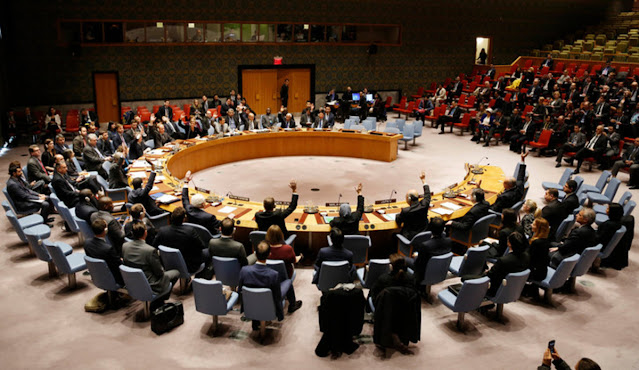
The Security Council today
extended for one year the mandate of the United Nations Organization
Stabilization Mission in the Democratic Republic of the Congo (MONUSCO),
expressing grave concern over the ongoing offensive by the 23 March
Movement (M23) in North Kivu, in violation of the ceasefire, and the
unauthorized presence of external forces from a neighbouring State in the
eastern part of the country.
Unanimously adopting
resolution 2765 (2024) (to be issued as document S/RES/2765 (2024)),
the Council — acting under Chapter VII of the Charter of the United
Nations — decided that the new mandate expires on 20 December 2025.
The mandate includes, on an exceptional basis and without precedent to
peacekeeping’s basic principles, its Force Intervention Brigade.
The draft further decided
that MONUSCO’s authorized troop ceiling will comprise 11,500 military
personnel, 600 military observers and staff officers, 443 police
personnel and 1,270 personnel of formed police units.
The text also decided to
retain the Mission’s key strategic priorities — protecting civilians,
supporting the stabilization and strengthening of State institutions and key
governance and security reforms. In this regard, it authorized MONUSCO to
use “all means at its disposal … to promptly and effectively prevent armed
groups’ attacks against civilians”.
By its other terms, the
text requested the Secretary-General — in his quarterly reports on MONUSCO — to
provide updates on progress towards the implementation of its gradual,
responsible and sustainable withdrawal to evaluate the Mission’s performance,
including its Force Intervention Brigade, and provide operational assessments
and recommendations.
Furthermore, the text
requested a tailored approach to MONUSCO’s gradual, responsible and sustainable
withdrawal, considering evolving conflict dynamics and protection risks in
hotspot areas across North Kivu and Ituri Provinces. It requested that
this strategy be shared with the Council by 31 March 2025.
“Today’s adoption can be a
moment that will significantly change the trajectory of the situation in the
Democratic Republic of the Congo towards the peaceful resolution of the
conflict,” said the representative of Sierra Leone, a co-penholder of the
draft. He supported Kinshasa’s efforts to protect civilians and stabilize
and strengthen State institutions. However, he cautioned that M23’s
territorial expansion remains deeply concerning, demanding that it end its
offensive and cease its expansion in the east of the country without delay.
France’s delegate, noting
that the text reaffirms that protection of civilians will be a priority task
for MONUSCO, said the Mission will also continue its disengagement.
Condemning all obstacles to the implementation of its mandate — including the
territorial expansion of M23 — he reaffirmed support for the Luanda process and
urged all stakeholders to continue negotiations.
After the vote,
Mozambique’s delegate, speaking also for Algeria, Guyana and Sierra Leone, stressed
that the resolution arrives “at a pivotal moment” for the Democratic Republic
of the Congo and the region. Highlighting MONUSCO’s efforts to support
Kinshasa in addressing the deteriorating security and humanitarian situation in
the eastern part of the country, he underscored that effective implementation
of its mandate remains crucial to the stability of the country and the
protection of civilians. Effective collaboration with the Government of
the Democratic Republic of the Congo is vital, particularly in planning the
next steps for the Mission’s drawdown and consolidating the drawdown in South
Kivu.
At the national level, he
underlined the critical importance of revitalizing the Nairobi process in
sustainably addressing the issue of local armed groups. Simultaneously,
the establishment of a robust State presence in the eastern regions is vital in
ensuring a well-equipped State apparatus capable of administering the territory
and countering all threats against civilians. He also highlighted the critical
contributions of the African Union in addressing the protracted conflict in the
eastern part of the country as well as Angola’s leadership and mediation
efforts. While national and regional efforts are vital, he called on the
Security Council to continue playing a constructive role in achieving a
peaceful conflict settlement.
China’s delegate, noting
that the peace process in the Democratic Republic of the Congo is at a critical
juncture, commended Angola’s efforts to promote the Luanda process. He
further voiced support for Kinshasa in safeguarding its national sovereignty,
independence and territorial integrity, adding that the UN should fully respect
the views and demands of its Government and ensure that the withdrawal of
MONUSCO does not create a security vacuum.
Meanwhile, the United
Kingdom’s delegate expressed disappointment that the Luanda process Heads of
State summit was postponed and urged all parties to engage with the process in
good faith. Also expressing concern about the surge in violence since
15 December, including the presence of Rwanda Defence Forces in the
Democratic Republic of the Congo, he called on parties to the conflict to
refrain from obstructing the Mission's operations.
“While we fully support the
extension of MONUSCO’s mandate”, the representative of the United States said,
“we remain dismayed that some members of the Council resisted the inclusion of
language factually describing Rwanda’s role in [the eastern part of the
country],” especially in the face of “extensive evidence” of Rwanda’s
deployment of troops in the Democratic Republic of the Congo and its influence
over M23 operations. She also expressed disappointment that Rwanda’s
President declined to attend the tripartite summit, “forfeiting a significant
opportunity to advance peace efforts”. Highlighting the ceasefire
agreement between the Democratic Republic of the Congo and Rwanda and the
establishment of the verification mechanism to monitor the ceasefire, she
added: “We must not lose sight of how far we have come.”
Source: https://press.un.org/en/2024/sc15949.doc.htm

.jpeg)