Showing posts with label security situation in south sudan. Show all posts

Tuesday, 2 May 2017

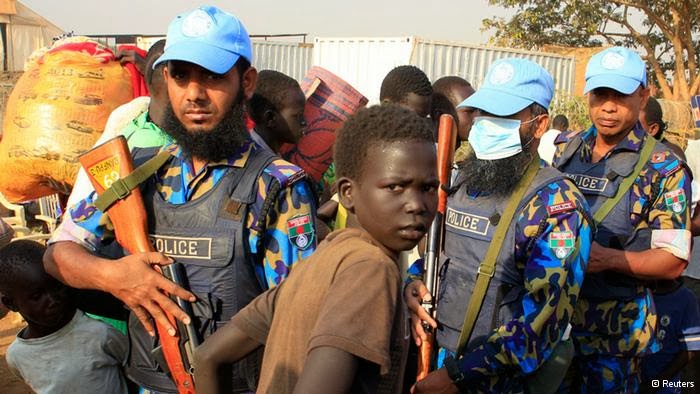
British troops join UN peacekeeping force in South Sudan

BRITISH TROOPS JOIN UN PEACEKEEPING FORCE IN SOUTH SUDAN
May 2, 2017 (JUBA) – The United Nations Mission in South Sudan (UNMISS) said about 400 United Kingdom troops arrived to serve as peacekeepers.

"British troops, proudly wearing their distinctive blue UN berets arrived in Juba today to join the United Nations Mission in South Sudan," UNMISS said in a statement that was released late on Tuesday.

According to UNMISS, the UK contingent will provide a Military Engineering Taskforce to the Malakal and Bentiu Protection of Civilians Sites (POCs), as well as a Level II Hospital in Bentiu.

Also, British troops will also conduct construction to improve the accommodation, security and drainage in the areas, along with the construction of a jetty on the Nile River and a helicopter landing site.

"Alongside their UNMISS colleague, their efforts will make a contribution to protecting civilians and creating conditions to enable the delivery of humanitarian aids," the UNMISS added.

With almost 400 troops in total, this will be one of the UK’s largest operational deployments across the world.

In addition to the UNMISS troops, 4,000 Regional Protection Force members approved by the UN Security Council last year began arriving in Juba this week to pacify the main city and provide security to vital infrastructure and routes leading out of Juba.


There are about 12,000 peacekeepers serving in UNMISS, protecting more than 200,000 civilians in six POCs. The civilians fled violence from government troops at the onset of conflict in December 2013.

Tuesday, 25 March 2014

Egypt ready to send peacekeepers to South Sudan

Minister Juuk arrived in Cairo on Saturday for a several-day visit, his first to Egypt.

EGYPT READY TO SEND PEACEKEEPERS TO SOUTH SUDAN
Egypt's interim president Adly Mansour said on Sunday that his country was ready to contribute troops to the United Nations peacekeeping force in South Sudan.

In a statement, the Egyptian presidency said the offer came during Mansour's meeting with visiting South Sudanese Defense Minister Kuol Manyang Juuk, who welcomed the Egyptian proposal.

Minister Juuk arrived in Cairo on Saturday for a several-day visit, his first to Egypt.

He met earlier today with Egypt's Defense Minister Abdel-Fattah al-Sisi to discuss political developments in South Sudan as well as developments on the regional scene, Egypt's state-run Middle East News Agency reported.

The two also discussed means of bolstering Egyptian-South Sudanese relations in all fields, the agency added.

South Sudan has been shaken by violence since last December, when President Salva Kiir accused ex-vice president Riek Machar of standing behind a failed coup attempt.

The violence has already claimed more than 10,000 lives.
The United Nations estimates that some 3.7 million South Sudanese are now "severely food insecure," while more than 867,000 have been displaced by the violence.

As of December 2013, the United Nation peacekeeping mission in Sudan is composed of 5,884 civilian, 5,508 military, and 376 police personnel and is headquartered in the capital Juba, according to the mission's website.

Friday, 21 March 2014

Thousands killed and abused in South Sudan says United Nations

THOUSANDS KILLED AND ABUSED IN SOUTH SUDAN SAYS UNITED NATIONS
United Nations peacekeeping chief said on Tuesday that Politically fueled ethnic violence in South Sudan since the mid of December has led to the brutal killing and abuse of thousands of civilians and sparked a government campaign to vilify the United Nations and harass United Nations personnel.

Herve Ladsous told the U.N. Security Council that despite a January 23rd  cease fire agreement, forces loyal to President Salva Kiir and rebel soldiers loyal to dismissed former vice president Riek Machar “continue to prioritize the pursuit of military gains over talks towards a comprehensive political settlement.”

Fighting that broke out Dec. 15 among presidential guards in the capital Juba quickly spread across the country and took on ethnic dimensions between the dominant Dinka tribe who support Kiir and the Nuer tribe loyal to Machar.

“Political polarization that has been caused by the conflict now affects the lives of every single person in South Sudan as well the operations of the government and country as a whole,” Ladsous said.

He said preliminary inquiry reports indicate that atrocities and very severe human rights violations were committed by both sides in the conflict, and he warned that the longer the fighting goes on “the more chances for further regional intervention will grow.”

Ladsous also warned that there will be no “meaningful progress” in talks organized by the regional group IGAD to resolve the crisis until the opposition’s key demand for the release of four remaining political detainees is resolved. The four went on trial for treason on March 11.

Ladsous urged the Security Council to condemn the campaign against the U.N. peacekeeping mission which is sheltering 75,000 of approximately 800,000 people displaced by the ongoing violence and to demand that Kiir condemn it and instruct government officials and his party to stop it.

The anti-U.N. campaign has brought the delivery of desperately needed humanitarian aid “almost to a standstill,” which is extremely critical as the rainy season will begin soon, he said.

“The security and humanitarian situation in South Sudan will continue to deteriorate until the parties fully engage in the political talks, respect the cessation of hostilities and allow freedom of movement for the United Nations and its partners,” he said.

Ladsous said the negative campaign against the U.N. peacekeeping mission known as UNMISS by some local and national officials has included public demonstrations, media articles, and harassment of U.N. personnel “including to the point of putting their lives in danger.”

A confidential note from the peacekeeping department to Security Council members, obtained by the Associated Press, lists dozens of violations of the U.N.’s status of forces agreement with South Sudan’s government. They include government forces restricting the movements of UNMISS patrols and helicopter operations, blocking contractors and supplies, assaulting an UNMISS national staff member, and harassing and detaining U.N. staff.

In response, Ladsous said, the United Nations needs to consider reducing its staff and limiting its activities “to the absolute minimum related to protection, human rights monitoring and support to humanitarian assistance.”

South Sudan’s U.N. Ambassador Francis Deng attributed the “negative outcry” against the U.N. mission known as UNMISS “to the trauma, frustrations, pain and anger caused by the devastating violence that broke out on Dec. 15.”

Luxembourg’s U.N. Ambassador Sylvie Lucas told reporters after closed council consultations that violations of the status of forces agreement and harassment of U.N. personnel “are unacceptable and agreed on the need to send a strong message.”

Secretary-General Ban Ki-moon has recommended that the council increase UNMISS’ strength for a year to the levels in temporarily agreed to in December - 12,500 troops and 1,323 and to re-prioritize its mandate to focus on protecting civilians, delivering aid and monitoring human rights.

Lucas said “questions were raised about the appropriateness of a new mandate for UNMISS.”

Monday, 27 January 2014

South Sudan: Peacekeepers Boost Security for Civilians On UN Mission's Bases

SOUTH SUDAN: PEACEKEEPERS BOOST SECURITY FOR CIVILIANS ON UN MISSION'S BASES
Joint police and military patrols and the use of metal detectors are among the security steps being taken by the United Nations peacekeeping mission in South Sudan (UNMISS) to protect some 65,000 displaced civilians seeking refuge on its bases and in the surrounding community.

"An array of security measures have been put in place," the Mission today confirmed in a news release. It noted that UN Police Commissioner Fred Yiga is meeting regularly with South Sudan's Police Inspector General and with the Central Equatoria Police Commissioner to address all security concerns.

Weapon searches are being undertaken at all the main bases, which include the capital Juba, Bor in Jonglei state, Bentiu in Unity state, and Malakal in Upper Nile state.

United Nations Police (UNPOL) supported by UNMISS military forces are heading the searches, which include 'combing' the areas with metal detectors. UNPOL and military are also jointly patrolling inside and in the immediate vicinity of all the sites, with troops guarding the perimeter.

Fencing, berms and ditches have been built, and displaced persons coming in and out are systematically screened and controlled, the Mission said. It is also planning additional security measures to further strengthen the camp perimeters.

"Another 63 additional UN police personnel arrived yesterday, bringing the total number of UNPOL reinforcements to 315," according to figures in the UNMISS news release.

An additional group is due to arrive next Friday. They will deploy in Formed Police Units to UNMISS bases in Juba, Malakal and Bentiu.

With that final group on the ground, the additional "more robust and armed police units" authorized by the UN Security Council last month will be completed, the Mission said.

As requested by UN Secretary-General Ban Ki-moon, the Council in December unanimously approved a temporary increase in the strength of the UNMISS of up to 12,500 military and 1,323 police from a current combined strength of some 7,000, through the transfer of units if necessary from other UN forces in the Democratic Republic of Congo (DRC), Darfur, Abyei, Côte d'Ivoire and Liberia.

The congestion of the sites also poses a challenge to the safety of civilians, UNMISS said. As of yesterday, it has moved hundreds of newly arrived displaced persons from the UN Tomping compound to the protection site at UN House where space is still available.

UNMISS reiterated that it is impartial in the ongoing conflict, and in the implementation of its mandate to protect all civilians "irrespective of who they are, where they come from and what their ethnic background is."


The fighting between anti- and pro-Government forces has continued even as political talks with the parties in the Ethiopian capital of Addis Ababa seek to establish a ceasefire. The talks are being held under the patronage of the Inter-Governmental Authority for Development (IGAD).

Thursday, 16 January 2014

Rebels attack town in eastern DR Congo, UN reports

(Peacekeepers serving with the UN Organization Stabilization Mission in the Democratic Republic of the Congo (MONUSCO) on patrol. UN Photo/Sylvain Liechti)

REBELS ATTACK TOWN IN EASTERN DR CONGO, UNITED NATIONS REPORTS
14 January 2014 – The United Nations today reported a new rebel attack in the eastern Democratic Republic of the Congo (DRC) as the region continues to suffer from deadly violence even after the defeat of a major dissident group, the M23, over a month ago.

In the latest violence, Mayi Mayi Sheka fighters attacked Pinga, in North Kivu province, but left after a 30-minute gun fight with the Congolese Armed Forces (FARDC), the UN peacekeeping force in the DRC (MONUSCO) reported.

Around 1,000 civilians sought refuge during the confrontation near the UN Mission’s base in Pinga, but only 90 remained there today, the others having returned home.

Briefing the Security Council yesterday by video link from Kinshasa, the DRC capital, Secretary-General Ban Ki-moon’s Special Envoy for the Great Lakes Region, Mary Robinson, warned that the positive atmosphere that prevailed last month following the defeat of the M23 rebel group has “vanished” and the region is going through a period of renewed turbulence.

This has been marked by deadly attacks in eastern DRC by another rebel group, the Allied Democratic Forces (ADF), the ongoing crisis in Central African Republic (CAR) and the eruption of fighting in South Sudan.

The Peace, Security and Cooperation Framework for the DRC and the Region, signed by 11 nations last February, remains “the best chance” to achieve sustainable peace, security, cooperation and development in the Great Lakes Region, she said.

In the same briefing Mr. Ban’s Special Representative for DRC Martin Kobler called the Framework a major milestone, along with the creation of an intervention brigade within MONUSCO and the use of unmanned aerial vehicles, which put all armed groups on notice that “we have the will and the means to take robust action at any time.

“In the coming weeks, we will finalize the review of our military deployment across eastern Congo. We will then have a more flexible force. We need it to be more agile, ready to deploy when it is needed and where civilians are threatened, to take on the threat,” he added, also noting that peace in eastern DRC can only be durable if its root causes are addressed.

“Restitution of State authority alone is not enough. Only regional cooperation and good governance will provide the peace dividend the population is expecting.”

Today he strongly condemned the latest attack and sent his condolences to the families of those who lost their lives and the Congolese people, stressing that MONUSCO will continue to work to consolidate the recent military gains.

The DRC has been torn apart by civil wars and factional fighting since it became independent from Belgium in 1960, but with the support of a series of UN missions a measure of stability has been restored to much of the vast country over the past decade.

But fighting between the Government and a variety of rebel and sectarian groups has continued to devastate the eastern regions, particularly North and South Kivu provinces.


In March, the Security Council authorized the deployment of an intervention brigade within MONUSCO, based in North Kivu province with a total of 3,069 peacekeepers, to carry out targeted offensive operations, with or without FARDC, against armed groups threatening peace in eastern DRC.

Ghana To Contribute 850 Troops To South Sudan Peacekeeping Force

GHANA TO CONTRIBUTE 850 TROOPS TO SOUTH SUDAN PEACEKEEPING FORCE
ACCRA, Jan 15 (BERNAMA-NNN- GNA) President John Dramani Mahama has announced Ghana will contribute 850 troops to South Sudan to help restore peace and stability to the country in response to a request from United Nations secretary-general ban Ki-moon.

The president, who announced the deployment of the Ghanaian battalion when Ethiopian Foreign Minister Dr Tedros A. Ghebreyesus called on him at his office here Tuesday, indicated that the National Security Council had met on Monday to ratify the troop deployment.

The Ethiopian minister, who discussed issues of common interest and the situation in South Sudan with Mahama, was accompanied by Ghana's Minister of Foreign Affairs and Regional Integration, Hannah Tetteh, Ghana's Ambassador to Ethiopia Francis Yankey and a 10-member Ethiopian delegation.

Mahama said a decision had been taken to mobilise the 330rd Ghana Battalion currently on peacekeeping duties in Cote d'Ivoire to South Sudan but upon a request from the UN for a fully-fledged battalion, 520 fresh troops and equipment were being mobilised to complement the 330 troops.

"As Ethiopia continues to teleguide the peace process (in South Sudan), we hope that normalcy will return to that country," he said and lauded Ethiopia for the initiative to help restore peace to South Sudan.

President Mahama also reiterated the need for Africa to embark on infrastructural projects that would facilitate the integration agenda, stressing the need for the creation of free trade areas to boost intra-African trade.

Dr.Tedros lauded Ghana for its global peacekeeping missions and indicated that when the Sudan conflict started, Ethiopia proposed a cessation of hostilities, the commencement of political dialogue and the provision of access to facilitate humanitarian efforts.


"The two parties are still meeting in Addis Ababa and they have agreed on a cessation of hostilities and the release of detainees," he said.

Saturday, 11 January 2014

Extra UN troops for South Sudan

EXTRA UNITED NATIONS TROOPS FOR SOUTH SUDAN
The United Nations says it's working "as quickly as possible" to deploy 5,500 extra UN peacekeepers to protect civilians in South Sudan where fighting is focused on the oil hub of Bentiu and the Nile river town of Bor.

Forces of South Sudan's President Salva Kiir sought to regain the oil hub of Bentiu from rebels on Friday. At the UN, peacekeeping chief Herve Ladsous said extra troops were being deployed to protect Sudanese civilians.

Briefing the UN Security Council, Ladsous said the violent breakup of South Sudan's administration in mid-December had left probably a quarter of a million South Sudanese displaced, including 60,000 sheltering at UN compounds and tens of thousands who had sought refuge in Uganda, Kenya and Ethiopia.

Ladsous said the deadline for the extra deployments was "between four and eight weeks." Troops and police would be drawn from other UN and African Union missions, across Africa, he added, and would go "into a pro-active footing."

South Sudan's fighting, often along ethnic lines, has pitted Kiir's SPLA forces against rebels loyal to former vice president Riek Machar.

8,000 sheltering at Bentiu
The UN said it was ready to fend off any attacks on its own compound at Bentiu where 8,000 people are sheltering. UN deputy spokesman Farhan Haq described the situation as "unclear and fluid."  The news agency AFP said fighting was also raging around the town of Bor, the only other major town in rebel hands.

Hundreds of people fled through crocodile-infested swamps of the White Nile river and told how gunmen had shot civilians with machine guns as they fled.

Peace talks in deadlock
With peace talks in neighboring Ethiopia in deadlock, US Assistant Secretary for Africa Linda Thomas-Greenfield said South Sudan – formed only 3 years ago – was "in danger of shattering."
"Each day the conflict continues, the risk of all-out civil war grows as ethnic tensions rise," she told US lawmakers in Washington. The talks have faced delays after Kiir refused a rebel demand to release 11 high-level political detainees.

Death toll 'substantially' higher
At the UN, Ladsous said he estimated that the death toll was "very substantially in excess" of the 1,000 deaths the UN cited just after the conflict erupted on December 15. The violence began as a clash between rival army units in what President Kiir said was an attempted coup by Machar.


Machar denied that accusation, accusing Kiir of trying to root out political opponents. The conflict has trimmed South Sudan's oil production by around a fifth, depriving the impoverished nation of its main source of foreign currency.

Thursday, 9 January 2014

THE SHROUD OVER RWANDA’S NIGHTMARE

THE SHROUD OVER RWANDA’S NIGHTMARE
WASHINGTON-Twenty years ago this Saturday, the commander of United Nations peacekeeping forces in Rwanda wrote a coded cable to his superiors in New York that has come to be known as the “genocide fax.” Citing inside information from a “top-level trainer” for a pro-regime militia group, Brig. Gen. Roméo Dallaire warned of an “anti-Tutsi extermination” plot.

The refusal by United Nations officials to approve the general’s plan for raids on suspected arms caches has been widely condemned as paving the way for one of the worst genocides since the Holocaust. But evidence submitted to the International Criminal Tribunal for Rwanda, some of it still under seal, reveals a murkier, more complicated situation than has often been portrayed.

New details about the mysterious informant known to General Dallaire as “Jean-Pierre” serve as a reminder that history can take a long time to reveal its secrets. Important documents that could shed light on the unresolved mysteries and ambiguities of the Rwanda genocide remain under lock and key.

It is now commonly recognized that the international community failed miserably in its efforts to protect the people of Rwanda. But even 20 years later, there is still much to learn. While the new evidence does not absolve the United Nations and Western governments for failing to take timely action, Jean-Pierre’s story illustrates the challenges that continue to vex decision-makers struggling to make sense of unfolding crises in countries like the Central African Republic or South Sudan.

The immediate trigger for the Rwandan genocide was the shooting down of a plane carrying President Juvenal Habyarimana on April 6, 1994. Over the next hundred days, Hutu militia groups murdered at least half a million members of the Tutsi minority, along with tens of thousands of “moderate” Hutus. These massacres took place against the backdrop of a war that pitted the Hutu-dominated regime against Tutsi-led insurgents who had invaded Rwanda from neighbouring Uganda.

Whether the genocide was planned, and was thus foreseeable, has been hotly debated by scholars, politicians and lawyers. The “genocide fax” has been a key part of this debate. Controversy has surrounded Jean-Pierre’s motives for cooperating with General Dallaire, the reliability of his information, and his fate after his request for protection was rejected by the United Nations.

We now know a lot more about Jean-Pierre Abubakar Turatsinze (his full name was established by the war crimes tribunal). Half-Hutu and half-Tutsi, he operated on both sides of Rwanda’s political and ethnic divide. While his prediction of mass murder of Tutsis by Hutu militia groups proved chillingly accurate, he misled United Nations peacekeepers on some key points.

Important details about his background and eventual fate are contained in a 2003 interview with his wife by tribunal investigators that has never been officially released but is now available. At the time of his marriage, in 1990, he worked as a driver for a senior Rwandan official. In the turmoil following the rebel invasion, Jean-Pierre used his connections to become an intermediary to the Interahamwe militia, whose principal goal was to defend the Hutu-dominated regime.

Curiously, the fact that he was married to a Tutsi and was the product of a mixed Tutsi-Hutu marriage does not seem to have affected his advancement in the Interahamwe, at least until the end of 1993. Around this time, he told his wife that he might have to kill her because the ruling party was planning to carry out “massacres.” As she told investigators, “because I am Tutsi and his mother was Tutsi, I understood this to mean that the massacres were going to be against the Tutsi population.”
ean-Pierre told General Dallaire’s aides in January 1994 that he had been instructed to register “all Tutsis” living in Kigali, apparently for “their extermination.” He also said that the Rwandan Army had been supplying the Interahamwe with weapons, and identified several arms caches, including one in the headquarters of the ruling party. The Interahamwe went on to commit many of the murders during the genocide.

The Arusha-based international tribunal has found that the Rwandan Army channelled weapons to the Interahamwe and provided military training to militia members. But tribunal judges were not convinced that the purpose of that training was the “extermination” of Tutsis, as Jean-Pierre claimed, rather than preparation for renewed hostilities with the Tutsi-led Rwandan Patriotic Front. They found that the Interahamwe had drawn up lists of “suspected opponents of the regime,” but such lists were “not focused exclusively on ethnicity.”

Evidence submitted to the tribunal showed that Jean-Pierre may have had other motives for seeking United Nations protection. He had fallen out with party leaders who suspected him of selling arms to rebels in Burundi. Some witnesses believe he might have been an agent of the Rwandan Patriotic Front assigned to penetrate the Interahamwe.

While there is no reliable evidence to back the claim that he was an R.P.F. agent in January 1994, it is clear that he had connections to opposition parties allied with the Tutsi-led rebels. According to United Nations cables, a Hutu opposition leader named Faustin Twagiramungu served as Jean-Pierre’s conduit to General Dallaire. These connections caused French and Belgian analysts to suspect that Jean-Pierre might be spreading “disinformation.”

In his 2003 memoir, “Shake Hands With the Devil,” General Dallaire raised the possibility that his informant had “simply melted back into the Interahamwe, angry and disillusioned at our vacillation and ineffectiveness, and become a genocidaire.” Jean-Pierre told the general’s aides at their final meeting in February 1994 that he was planning to go to Zaire, for “commando training.”

Instead, he went to Tanzania where he joined the R.P.F., according to his wife. In late March, two weeks before the president’s assassination, he moved to a rebel-held enclave in northern Rwanda, where he was reported to be “in very good books with senior members of the R.P.F.” In late 1994, a minister in Rwanda’s new Tutsi-led government informed the family that Jean-Pierre had been “killed in battle.”

The circumstances of his death remain a mystery. As his wife told investigators, “I do not know how he died and where.” She was unable even to establish whether he was “surely dead.”

General Dallaire has told the tribunal that he operated on “instinct” in sending the genocide fax, which was followed up by a series of warnings to New York in early 1994 that were rebuffed or ignored. He sensed that the peacekeeping force had to reassert its authority. But his superiors in New York needed something more than their field commander’s instincts to justify aggressive action.

Newly released State Department records show that United Nations officials briefed the United States, Belgium and France on the emerging crisis, but there was zero enthusiasm in the Clinton administration following the “Black Hawk Down” debacle in Somalia in October 1993. Much stronger intelligence would have been necessary to disrupt the passivity of senior decision makers.

The “Jean-Pierre” revelations are a tantalizing indication of how much we still have to learn about the Rwandan genocide. Records that could shed light on whether it could have been prevented are still classified in Washington, New York, Paris, Brussels, Geneva, Arusha and Kigali — unavailable to the public despite pledges by international leaders to fully investigate the tragedy. In order to draw the correct lessons from history, we must first establish all the facts.

Michael Dobbs directs a Rwanda documentation and oral history project for the United States Holocaust Memorial Museum and the National Security Archive.
(A version of this op-ed appears in print on January 10, 2014, in The International New York Times)

Sunday, 5 January 2014

Peacekeepers Reinforcing In South Sudan Amid Continued Fighting

PEACEKEEPERS REINFORCING IN SOUTH SUDAN AMID CONTINUED FIGHTING
(Newsroom America) - The security situation in South Sudan remains "fluid", the United Nations peacekeeping mission in the country said, confirming that it is sending reinforcements to areas affected by the current fighting between pro- and anti-Government troops, particularly Bor, Malakal, Bentiu and Juba.

"This is critical to enable the Mission to deliver on its mandate to protect civilians," UNMISS said.

It specified that thousands of additional police, military, logistics support and selected civilian staff are being relocated to the affected areas, per the Security Council's authorization.

Three weeks of violence in the world's newest country have claimed thousands of lives and forced about 200,000 people from their homes, many seeking refuge inside UN bases.

UNMISS said that two stand-by police components known as Formed Police Units have been deployed to strengthen security and order for civilians on UN compounds. A medical team from the UN Mission in Cote d'Ivoire (UNOCI) arrived yesterday in Juba to bolster support at the UN Juba bases. Logistical support for air operations is being provided by the UN Mission in the Democratic Republic of the Congo, MONUSCO.

More aircraft are arriving this week to assist with transport of essential supplies to troops and civilians, the Mission confirmed. They will be followed by additional police from Nepal, and later also troop reinforcements.

The UN's humanitarian wing has significantly reinforced its ability in Juba and other key areas of the country, such as the Lakes State county of Awerial where up to 76,000 people have gathered, in order to meet the needs of civilians.

According to the Mission, close to $100 million have been raised in the past 72 hours to bring in additional supplies and staff to respond to the evolving situation.


Humanitarian partners in the country had issued a $166 million plan to assist some 628,000 people over the next three months. It includes provision of protection, water, food, shelter and healthcare. It also aims to help those that have left Sudan and sought refuge in South Sudan's Unity and Upper Nile states. UN officials have repeatedly called for a cessation of violence and a political solution to the conflict, including accountability for grave human rights violations. Representatives of President Salve Kiir and the feuding former deputy president Riek Machar are meeting in the Ethiopian capital of Addis Ababa, in talks mediated by the Intergovernmental Authority on Development (IGAD). In a New Year's message to the people of South Sudan, UNMISS chief Hilde Johnson voiced support for the talks and summarized the agenda: an immediate cessation of hostilities, the release of all political detainees, political dialogue and humanitarian access.

Search This Blog

Facebook page like

Powered by Textbook Widget

Popular Posts