Showing posts with label Pakistan contribution in UN. Show all posts

Thursday, 14 December 2017

WHICH ASIAN COUNTRY PROVIDES THE MOST TROOPS FOR THE UN PEACEKEEPING MISSION

WHICH ASIAN COUNTRY PROVIDES THE MOST TROOPS FOR THE UN PEACEKEEPING MISSION
The United Nations does not have an army but it has peacekeepers for sustaining peace in conflict ridden areas. If the peacekeeping force was ranked against the national militaries it would be the 44th largest army in the world. There are a total of over 100,000 UN peacekeeping personal consisting of 91,132 troops, 13,563 police and 1,811 military experts from 123 countries. However the peacekeeping army is dominated by the South Asian troops which have traditionally been the top providers.

In Asia, it is India that contributes the most number of troops with 7,471 personnel stationed worldwide.  India has participated in the most peacekeeping missions than any other country.

Pakistan is the second highest contributor in Asia with 7,161 troops in the UN missions.  It was the first country to respond to crisis in Somalia and sent 500 troops to Somalia in 1992.  Bangladesh is the third highest troop contributor to the UN. The country has served in 58 peacekeeping missions across 40 countries since 1988.   Nepal has contributed to 11 peace peacekeeping missions most of which are in Africa.

Indonesia first contributed troops in the 1950s and after a sustained absence has been once again actively contributing to the UN peace keeping missions.

China’s troop contribution has increased over the last many years and it is the 12th largest provider of troops in the world and sixth highest in Asia.  Mongolia contributes 950 troops for UN peacekeeping mission.

Malaysia, South Korea and Cambodia individually contribute less than one thousand troops. Japan’s contribution to peacekeeping has diminished over a period of time.  It contributes a handful of personnel for UN missions.


Compared to its neighbours Sri Lanka remains an outlier in terms of troop contribution to the UN.  Bhutan, Australia, Brunei, Thailand, Vietnam and Myanmar together contribute just hundred and forty personnel to the peace keeping missions of the UN.

Monday, 29 May 2017

FIVE PAKISTANIS HONOURED WITH UN MEDALS POSTHUMOUSLY

FIVE PAKISTANIS HONOURED WITH UN MEDALS POSTHUMOUSLY
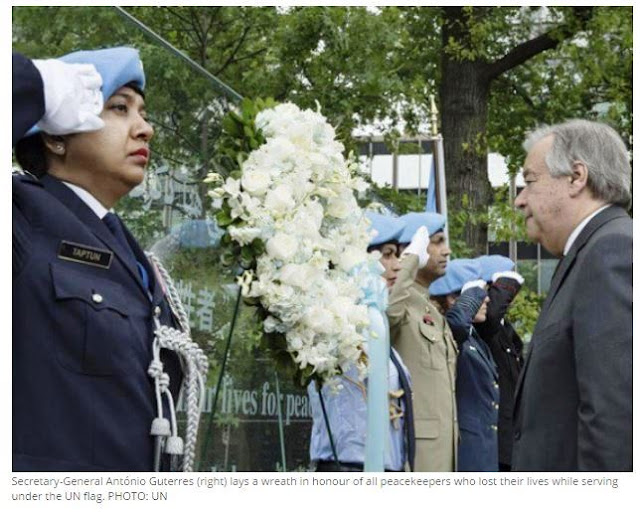
Five martyred peacekeepers from Pakistan received the Dag Hammarskjöld Medal posthumously at a ceremony to mark International Day of UN Peacekeepers in New York, on Wednesday.

At the UN Headquarters in New York, the Secretary-General Antonio Guterres presided over a wreath-laying ceremony in honour of all peacekeepers, who lost their lives while serving under the UN flag in 2016. These included 117 military, police and civilian peacekeepers from 43 countries. Among them were five Pakistani peacekeepers, who made the ultimate sacrifice for the cause of peace.

The five recipients from Pakistani were Havildar Abdul Majeed Khan and Havildar Zishan Ahmed, who served with the United Nations Organisation Stabilisation Mission in the Democratic Republic of the Congo (MONUSCO); Lt-Colonel Muhammad Ashraf, who served with the United Nations Operation in Ivory Coast (UNOCI); Naik Qaiser Abbas, who was deployed with the United Nations Multidimensional Integrated Stabilisation Mission in the Central African Republic (MINUSCA); and Ms Shabnam Khan who served in a civilian capacity with the United Nations Assistance Mission in Afghanistan (UNAMA).

Pakistan is the third largest contributor of military and police personnel to UN peacekeeping. It currently deploys more than 7,100 uniformed personnel to the UN peace operations in the Central African Republic, Ivory Coast, the Democratic Republic of the Congo, Haiti, Liberia, South Sudan, Sudan and the Western Sahara. Acting Pakistan Permanent Representative to UN, Nabeel Munir, received the awards on behalf of the families of the fallen peacekeepers.

Speaking on the occasion to a large and distinguished gathering. UN Secretary General said, “Every day, peacekeepers help bring peace and stability to war-torn societies around the world.”

“Their sacrifice only strengthens our commitment to ensuring that United Nations peacekeepers continue protecting civilians in harm’s way, promoting human rights and the rule of law, removing landmines, advancing negotiations and securing a better future in the places they are deployed,” he said. “Now, more than ever, it is essential that we continue investing in peace around the world.”

He also expressed his “deepest condolences and appreciation” to the family members and friends of those who died, as well as his “deepest sorrow and greatest appreciation” to the countries that contributed the troops and police officers.


Wednesday, 17 May 2017

PENDING PAYMENTS DOESN'T REFLECT UN'S PEACEKEEPING COMMITMENT

PENDING PAYMENTS DOESN'T REFLECT UN'S PEACEKEEPING COMMITMENT.
India has said, the UN owing over USD 700 million to member states, including India, for peacekeeping services does not reflect the world body's commitment to peacekeeping operations.

The UN owes USD 777 million to 86 member states, including India, for Troops/Formed Police Units and Contingent Owned Equipment claims as on March 2017. Of this, outstanding payment to Ethiopia was the highest at USD 64 million. The UN owes India USD 55 million for peacekeeping operations, the second highest amount, followed by USD 53 million to Bangladesh and USD 41 million to Pakistan.

Counsellor in the Permanent Mission of India to the UN Anjani Kumar said last week at a session of the General Assembly s Fifth Committee, which deals with administrative and budgetary issues, that outstanding payment of dues to troop and police contributing countries for their services rendered is a matter of concern to many, including India.

He noted that finance or reimbursements are not at all the basis for India's longstanding commitment to peacekeeping operations, yet "for the kind of services rendered by the peacekeepers and the risks undertaken by them for ensuring collective peace and security, what UN pays to them is a token amount."

"Therefore, at a time when the TCCs and PCCs are being asked to make greater sacrifices, pending payments to such a large number of countries does not reflect UN's commitment to peacekeeping operations, Kumar said, referring to Troop Contributing Countries (TCCs) and Police-Contributing Countries (PCCs).

Kumar emphasised it is important that payment of assessed contributions is not withheld or linked to political motives."India firmly believes that the UN is a global role model and must lead by example in all activities under its umbrella, including the peacekeeping operations," he said, adding that timely payment of assessed contribution is essential for the financial health of the peacekeeping operations.

India is the largest cumulative troop contributor, having provided almost 200,000 troops in nearly 50 of the 71 peacekeeping missions mandated over the past six decades, including 13 of the current 16 missions.

The first-ever Female Formed Police Unit provided by India and deployed in Liberia received recognition for providing a role model for encouraging female participation in police and for pursuing gender balance more widely.

About 168 Indian troops have made the supreme sacrifice in the line of duty under the UN Flag. Kumar further stressed that for greater efficiency of peacekeeping operations, there should be unwavering commitment to the stated mandate of each peacekeeping mission, operational effectiveness with respect to the situation on the ground and the welfare and security of the peacekeepers themselves.


"The Troop-Contributing Countries and Police-Contributing Countries should be fully consulted at all stages of such decision-making process, he said."A one-sided approach to economise may prove to be counter-productive. We must ensure that the peacekeepers who are deployed in the harm's way must be adequately resourced to carry out their mandated tasks effectively. Any dilution of their resources will inevitably impact their effectiveness, he said.

Search This Blog

Facebook page like

Powered by Textbook Widget

Popular Posts