Search Previous Papers

Wednesday, 31 May 2017

What are the requirements for joining the UN Police ?

WELCOME TO THE
QUESTIONS & ANSWERS 
SESSION.

Q.No.2  What are the requirements for joining the UN Police ?

MINIMUM REQUIREMENTS BY UNITED NATIONS police division FOR recruitment.

Age

·         25-62 years;
·         Preference under 55 years.


Number of years of professional experience

·         Five (5) years excluding training;
·         Retired personnel can be deployed if retired within the past 5 years.


Language proficiency

·         Mandatory language test (reading, listening, report writing and oral interview);
·         Language of Operation, French and English;
·         Passing score 60 % or above.


Driving skills proficiency

·         One (1) year of recent driving experience;
·         In possession of a valid national driving license for at least one year;
·         Two mandatory driving tests one by Selection and Assistance Team and one in the respective peacekeeping mission where deployed.


Use of firearms proficiency

·         Mandatory firearms test.


Computer skills

·         Basic computer knowledge


Desirable complementary skills

·         Previous experience in a UN mission;
·         Proficiency in map reading, land navigation, use of global positioning systems;
·         Knowledge of basic negotiation, mediation and conflict resolution;
·         Interviewing techniques;
·         Basic first aid.


Personal Qualities

·         Good judgment, supported by a common-sense approach to problem-solving;
·         Objective attitude, displaying tact and impartiality;
·         Polite demeanour, combined with a firm but flexible and honest approach;
·         Considerable self-discipline and patience;
·         A friendly, open approach to other nationalities;
·         Demonstrable leadership skills.

Monday, 29 May 2017

UNPOL STEPS UP ANTI-CRIME CRACKDOWN AT BENTIU PoC SITE SOUTH SUDAN

UNPOL STEPS UP ANTI-CRIME CRACKDOWN AT BENTIU PoC SITE SOUTH SUDAN

The United Nations mission in South Sudan - UNMISS has stepped up its crime control measures to ensure security and safety in the Protection of civilian site at the UN base in Bentiu. Bentiu PoC sites currently shelters more than 120 thousand internally displaced persons.

The United Nations police have been running an anti-crime campaign focussed at tackling crimes that have the greatest impact on the IDPs such as - violence and disorder, and antisocial behaviour.

Francis Yiribare, the UNPOL PoC site coordinator for the Bentiu PoC site said the campaign by the UN Police in Bentiu is designed to rid the PoC site of violence. Yiribera spoke with Zenebe describing the kind of crimes UNPOL is dealing with in the PoC site.


PEACEKEEPERS EARN INTERNATIONAL ACCLAIM FOR BANGLADESH

PEACEKEEPERS EARN INTERNATIONAL ACCLAIM FOR BANGLADESH
Bangladesh has achieved global credentials as a “role model” to the cause of international peace and security through its UN peacekeeping missions. The armed forces and police achieved this acclamation due to their professionalism, commitment, impartiality, integrity and humane attitude while participating in more than 50 UN missions in about 40 countries in less than three decades. Participating in a round table discussion on “Bangladesh and UN Peacekeeping: Challenges and Prospects” organised by The Daily Star Bangladesh, retired top generals and high civil officials said Bangladesh is now reputed as a nation of peacekeepers.

The round table was organized to mark the International Day of United Nations Peacekeepers to be observed on May 29th 2017. Not only are the Bangladeshi peacekeepers contributing to the peaceful settlement of international disputes and maintenance of global peace and security, they are also contributing to the nation-building activities to supplement UN mandates, they said. As a result, Bangladesh has become the second language of Sierra Leone, Liberia has named a street of its capital after Bangladesh, and a few African countries have set up schools naming “Bangladesh Friendship School”.

Bangladesh armed forces and police now have the capability to take up any peacekeeping assignment, even in a hostile situation, in any part of the world because of their commitment and dedication to global peace and stability, they added. Footprints of Bangladeshi peacekeepers are now evident in almost all the troubled areas of the world -- from Haiti to East Timor and from Lebanon to Democratic Republic of Congo. Bangladeshi peacekeepers are in almost everywhere and committed to remaining so in the days to come, the speakers noted.

Bangladesh began its peace support mission in 1988 with a contribution of 15 army officers as military observer to the UN peacekeeping operations in the United Nations Iran-Iraq Military Observer Group (UNIIMOG). Mentioning that peacekeeping has grown from monitoring ceasefires to multi-dimensional tasks, the speakers highlighted some challenges ahead, including countering terrorism. Bangladesh armed forces need rigorous training on the methods and mechanisms for peace-making and peace-building, they observed. The discussants pointed out that peacekeeping is part of Bangladesh's constitution. Article 25(1) states the importance of promoting international peace and security. The armed forces and police have fulfilled the dreams of Bangabandhu's declaration of Bangladesh's commitment to international peace, said Maj Gen (retd) Kazi Ashfaq Ahmed in his keynote presentation.

There are currently 16 peacekeeping operations led by the UN Department of Peacekeeping Operations. As of April 30, Bangladesh was the fourth largest contributor to UN peacekeeping missions with armed forces and police personnel standing at 6,815 in eight missions. Currently, Ethiopia, India and Pakistan are the top three troop providers. Bangladesh topped as a troop contributing nation for couple of times, including in 2015. During yesterday's discussion, two other keynote papers were presented by Air Commodore (retd) Anisur Rahman and Commodore (retd) MN Absar. Twenty speakers, including former chiefs and senior most officials of three forces, former foreign secretaries and diplomats, police personnel and a university teacher, took part in the five-hour long discussion.

 Former army chief Lt Gen (retd) M Nooruddin Khan said they had to go through many difficulties at the beginning of the missions. Even it was a critical decision for the country to send troops to the UN mission in Kuwait against Saddam Hossain, the then Iraqi president who had good relations with Bangladesh, he said. Narrating various hostile situations he faced during his deployment as a peacekeeper in Georgia, former army chief Lt Gen (retd) M Harun-Ar-Rashid said they fared extremely well in any situation during the peacekeeping operations.

He suggested conducting an analysis of the peacekeeping operations participated by the Bangladeshi troops. “We don't think we have done everything. We have to think and analyse how we could do better in future.” Air Commodore (retd) Anisur Rahman said the Bangladesh Air Force (BAF) has earned a good reputation in the UN, but it faces a number of difficulties in operating and maintaining its forces in mission areas.UN missions might get increased in future and the BAF should be ready to undertake any mission with its competence. Former navy chief Rear Admiral (retd) Shah Iqbal Mujtaba said the participation of the navy was limited compared to the army and the air force. “Nowadays, we have gained momentum and we will progress Inshallah,” he said, adding that naval ships joined the UN mission in 2010.

Rear Admiral (retd) ASMA Awal stressed the need for more vigorous diplomacy so that Bangladesh could get higher positions in UN headquarters and peacekeeping missions. Highlighting the foreign ministry's crucial role in negotiating in UN Security Council and other bodies regarding the country's participation in UN missions, former foreign secretary Hemayet Uddin said, “To uphold the legacy of Bangladesh, it is necessary that our professionals develop their skills on key areas of international diplomacy that go hand in hand with the peacekeeping operations.” The former secretary said the country's women peacekeepers played an exemplary role in peace-making by providing comfort to the victims of gender-based violence in war-ravaged countries. Bangladesh became the world's first all-woman UN peacekeeping contingent, he said. Maj. Gen. (Retd.) Fazle Elahi Akbar said there were allegations of sexual abuse involving peacekeepers, but Bangladeshi troops have good reputations in this regard.

Dhaka University teacher Niloy Ranjan Biswas said the experience of peacekeepers must be documented systematically so that the future generation of peacekeepers could learn from those and develop themselves accordingly. He also said there must be a comprehensive peacekeeping strategy in the country. Praising their contribution, The Daily Star Editor and Publisher Bangladesh Mahfuz Anam said, “As soldiers, you are trained to serve your country. But when you go to another country and serve the people of those countries, then it really shows your humanity.” “You have served the people of other countries with great intensity, devotion, humanity and empathy.”

Brig Gen. (R) Shahedul Anam Khan, associate editor of The Daily Star Bangladesh, moderated the discussion while former Navy chief Admiral (R) M. Farid Habib, Lt. Gen. (R) Md Mainul Islam, Lt Gen (R) Abdul Hafiz, former ambassador and foreign secretary Shamsher M Chowdhury, Commodore (R) MN Absar, Brig Gen (R) Abdul Hakim Aziz, Maj Gen (R) Rezanur Rahman Khan, former additional IGP AMB Bazlur Rahman, DIG of police Mahbubur Rahman, Rear Admiral (R) ASMA Baten, former ambassador Rashed Ahmed, Air Commodore (R) Ishfaq Ilahi Choudhury, Brig Gen (R) Khondokar Kamaluzzaman, Brig Gen (R) Salim Akhtar, and former ambassador Shamim Ahmed also spoke.

FIVE PAKISTANIS HONOURED WITH UN MEDALS POSTHUMOUSLY

FIVE PAKISTANIS HONOURED WITH UN MEDALS POSTHUMOUSLY
Five martyred peacekeepers from Pakistan received the Dag Hammarskjöld Medal posthumously at a ceremony to mark International Day of UN Peacekeepers in New York, on Wednesday.

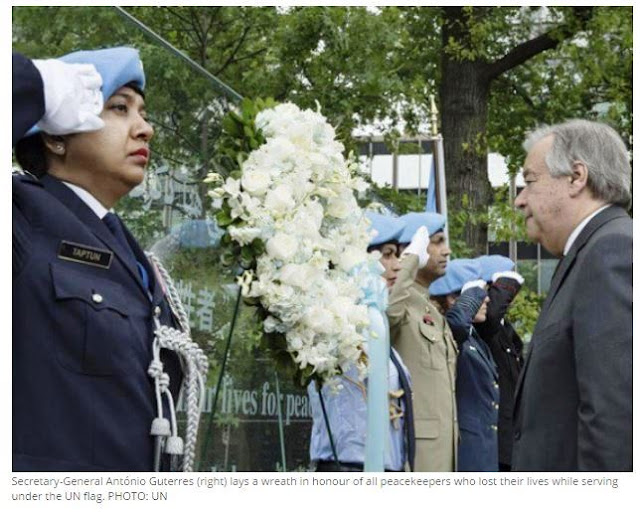
At the UN Headquarters in New York, the Secretary-General Antonio Guterres presided over a wreath-laying ceremony in honour of all peacekeepers, who lost their lives while serving under the UN flag in 2016. These included 117 military, police and civilian peacekeepers from 43 countries. Among them were five Pakistani peacekeepers, who made the ultimate sacrifice for the cause of peace.

The five recipients from Pakistani were Havildar Abdul Majeed Khan and Havildar Zishan Ahmed, who served with the United Nations Organisation Stabilisation Mission in the Democratic Republic of the Congo (MONUSCO); Lt-Colonel Muhammad Ashraf, who served with the United Nations Operation in Ivory Coast (UNOCI); Naik Qaiser Abbas, who was deployed with the United Nations Multidimensional Integrated Stabilisation Mission in the Central African Republic (MINUSCA); and Ms Shabnam Khan who served in a civilian capacity with the United Nations Assistance Mission in Afghanistan (UNAMA).

Pakistan is the third largest contributor of military and police personnel to UN peacekeeping. It currently deploys more than 7,100 uniformed personnel to the UN peace operations in the Central African Republic, Ivory Coast, the Democratic Republic of the Congo, Haiti, Liberia, South Sudan, Sudan and the Western Sahara. Acting Pakistan Permanent Representative to UN, Nabeel Munir, received the awards on behalf of the families of the fallen peacekeepers.

Speaking on the occasion to a large and distinguished gathering. UN Secretary General said, “Every day, peacekeepers help bring peace and stability to war-torn societies around the world.”

“Their sacrifice only strengthens our commitment to ensuring that United Nations peacekeepers continue protecting civilians in harm’s way, promoting human rights and the rule of law, removing landmines, advancing negotiations and securing a better future in the places they are deployed,” he said. “Now, more than ever, it is essential that we continue investing in peace around the world.”

He also expressed his “deepest condolences and appreciation” to the family members and friends of those who died, as well as his “deepest sorrow and greatest appreciation” to the countries that contributed the troops and police officers.


Thursday, 25 May 2017

9 FACTS YOU NEED TO KNOW ABOUT THE HUMANITARIAN CRISIS IN YEMEN

9 FACTS YOU NEED TO KNOW ABOUT THE HUMANITARIAN CRISIS IN YEMEN
A brutal conflict is devastating Yemen, where two thirds of the population now need humanitarian assistance or protection in order to survive. The situation is deteriorating so quickly, it could reach a point of no return this year.

The humanitarian community requested US$2.1 billion for 2017 to meet Yemen’s most urgent needs. But by mid-April, barely 15 per cent of this appeal had been funded.

1. YEMEN IS NOW THE WORLD’S LARGEST HUMANITARIAN CRISIS.
Due to the escalation of conflict in 2015, an estimated 18.8 million people in Yemen need some form of humanitarian assistance or protection.

2. THE CRISIS IS ENTIRELY MAN-MADE
The conflict is taking an enormous toll on Yemen’s civilian population. More than 7,000 people have been killed and more than 42,000 have been injured since the violence escalated just over two years ago. Air strikes and localized fighting have destroyed the economy and moved an already weak and impoverished country towards social, economic and institutional collapse.

3. YEMEN IS ON THE BRINK OF FAMINE
Yemenis are facing the world’s largest food security crisis. Some 7 million people do not know where their next meal will come from, and one in every two children is stunted.

4. MILLIONS OF PEOPLE HAVE FLED THEIR HOMES
An estimated 2 million people in Yemen are internally displaced due to the crisis. Many have taken refuge in schools or informal settlements, with limited access to essential services.

5. THE CONFLICT HAS SEVERELY DISRUPTED THE IMPORTATION OF ESSENTIAL GOODS INTO YEMEN.
Yemen relies on imports for 80 to 90 per cent of its food, fuel and medicine. Al Hudaydah Port—the country’s main port and a lifeline for 60 per cent of food insecure people—is operating at partial capacity.

6. THE HEALTH SYSTEM IS ON THE VERGE OF COLLAPSE
Stocks of medical supplies are dangerously low in Yemen, and many doctors and nurses are working for free or receiving substantially reduced wages. Humanitarians estimate that every 10 minutes, a child under age 5 dies of preventable causes.

7. CLEAN WATER IS NOW A SCARCE COMMODITY
More than 8 million people lack access to safe drinking water and sanitation in Yemen. The population is now at risk of disease outbreaks, such as cholera, dengue and scabies.

8. WOMEN AND GIRLS ARE AMONG THE MOST VULNERABLE PEOPLE IN THE CRISIS.
The crisis is taking a heavy toll on women and girls. They face frightening prospects, including abuse, exploitation and forced marriage. Gender-based violence was prevalent before the crisis, but UNFPA estimates that rates have increased by more than 63 per cent since 2015, meaning that some 2.6 million women and girls are now at risk.

9. THE HUMANITARIAN COMMUNITY IS READY TO RESPOND, BUT IT URGENTLY NEEDS FINANCIAL SUPPORT AND ACCESS.
Today, some 120 organizations—including 80 national organizations—are working tirelessly to respond to the crisis. So far this year, the humanitarian community has reached millions of people with life-saving assistance. But without access to affected people and adequate funding, millions of lives will continue to hang in the balance.

UN CHIEF WANTS $40.5 MILLION FOR HAITI CHOLERA VICTIMS

UN CHIEF WANTS $40.5 MILLION FOR HAITI CHOLERA VICTIMS
UNITED NATIONS- Secretary-General Antonio Guterres is asking UN member states to transfer $40.5 million in unspent funds from Haiti's peacekeeping mission to help communities and victims of a cholera outbreak that has afflicted over 800,000 people, according to a report released Tuesday.

Guterres said in the report to the Security Council that the money is desperately needed for a trust fund that the UN had hoped would raise $400 million to provide aid to the families of victims and afflicted communities, and to help eradicate the disease.

So far, the report said only $2.67 million has been contributed to the fund from Chile, France, India, Liechtenstein, South Korea, Sri Lanka and Britain. Canada and Japan have separately contributed $8.5 million to assist Haiti.

The Security Council voted unanimously last month to end the U.N. peacekeeping mission in Haiti in mid-October after 13 years. The peacekeepers helped normalize a country in chaos after political upheaval in 2004, but U.N. troops from Nepal were widely blamed for introducing cholera to Haiti after a devastating earthquake in 2010. The death toll as of April was over 9,500.

For years the U.N. had denied or been silent on the longstanding allegations that it was responsible for the outbreak, while responding to lawsuits in U.S. courts by claiming diplomatic immunity. Last August, a U.S. appeals court upheld the United Nations' immunity from a lawsuit filed on behalf of 5,000 Haitian cholera victims who blame the U.N. for the epidemic.

After the ruling, then secretary-general Ban Ki-moon said he deeply regretted the suffering that cholera has caused and the U.N. had a moral responsibility to the victims. He later apologized for the U.N. not doing enough to contain the spread of cholera and announced a new U.N. approach to eliminate the disease which sought to raise $400 million.

Guterres asked the 193 U.N. member states to consider voluntarily waiving the return of the $40.5 million balance and credits in the 2015-16 budget for the Haiti peacekeeping mission and put the money in the cholera trust fund.

In a renewed effort to raise voluntary contributions, Guterres said he has also written to every member state and has decided to appoint a high-level envoy "to develop a comprehensive fundraising strategy." He said several countries have responded to his letter "and some additional voluntary contributions are anticipated."


Wednesday, 24 May 2017

INDIA LOST 35 SOLDIERS IN 17 YEARS OF PEACEKEEPING OPERATIONS

INDIA LOST 35 SOLDIERS IN 17 YEARS OF PEACEKEEPING OPERATIONS
CHANDIGARH: As many as 35 Indian soldiers were killed in UN peacekeeping operations across the world during the last 17 years. Most number of fatal battle causalities has been in Congo, with the toll highest between 2010 and 2015. Bathinda-based RTI activist HS Grewal, who procured the information under RTI Act, 2005, from the ministry of defense, rued that many of these Indian soldiers killed abroad do not get the recognition they deserve. While 17 Indian soldiers have died in Congo, there have been 10 battle casualties in Sudan, five in Afghanistan and one each in Ethiopia, Lebanon, Sudan and Israel.

India lost seven soldiers in the UN Mission in South Sudan (UNMISS) in 2013. Five of them died in an ambush by about 200 attackers near Jonglei State while escorting a UN convoy. The list of deceased included Lt Col Mahipal Singh, Lance Naik Nand Kishore Joshi, Havildar Heera Lal, Naib Subedar Shiv Kumar Pal and Havildar Bharat Sasmal.

In Congo, the causalties include Indian troops deployed as peacekeepers in the UN Organization Stabilization Mission in the Democratic Republic of the Congo (MONUSCO). In 2014, eight Indian soldiers who died while serving in the UN peacekeeping operations were posthumously awarded a prestigious UN medal for their courage and sacrifice in the line of duty An Agra-based soldier, Gagan Punjabi was gunned down by a group of 15 masked men in 2015 at a pub in Aru town of Congo, near the Uganda-Congo border. He was shot while attending the birthday party of a local resident in the eatery. He was part of the UN's MOVCON (movement-control) mission.

India has been among the largest contributors to UN peace-keeping operations and contributed more than 1,70,000 troops to 43 of the 68 UN peacekeeping missions since its inception over 60 years ago. Over the past few years, Indian soldiers have been deployed in 10 critical UN peacekeeping missions across the world including Haiti, Congo, Golan Heights, Lebanon and Cote d'Ivoire.

Death of Peacekeepers.
CONGO
Year
2002
2005
2010
2011
2012
2013
2014
2015
Total No. of Death
02
03
04
01
04
01
01
01

Total: 17
Afghanistan
Year
2002
2008
2010
Total No. of Death
01
01
03

Total: 05
Ethiopia
Year
2005
Total No. of Death
01

Total: 01
Sudan
Year
2007
2009
2013
Total No. of Death
01
02
07

Total: 10
Lebanon
Year
2012
Total No. of Death
01

Total: 01
Israel

Year
2015
Total No. of Death
01

Total: 01

Search This Blog

Facebook page like

Powered by Textbook Widget

Popular Posts